By Dorcas Achi
Prominent Muslim Cleric, Barr. Suleiman Njoku, Imam of Imo State, has affirmed his unwavering commitment to supporting the Special Seat Bill for women in the state.
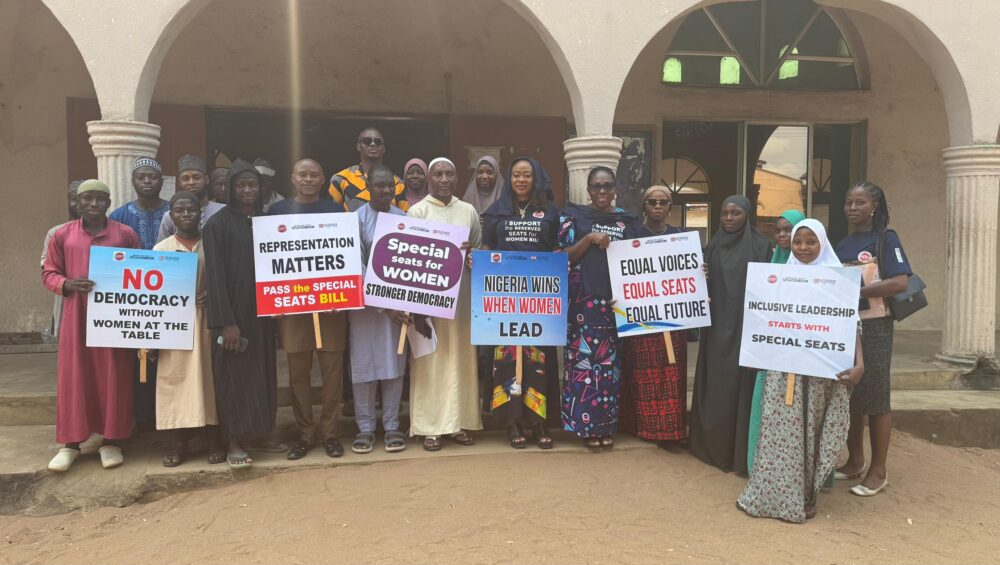
He made this known during an advocacy visit by a delegation from SIDEC to the Imo Central Mosque on Friday, 13th March, 2026. The visit aimed to discuss the Reserved Seats bill for women, as part of PROJECT IMPACT – Inclusive mobilization for participation, advocacy and civic transformation, a collaborative initiative between SIDEC and the Nigeria Civic Society Situation Room, funded by the UK Foreign, Commonwealth and Development Office (FCDO).
The organization is undertaking an inclusive mobilization drive in Anambra and Imo States, engaging diverse stakeholders across religious, traditional, legislative, and political spheres to garner support for the reserved seat bill, aimed at addressing the existing imbalance in women’s representation in Nigeria’s legislative bodies, particularly at the national and state assembly levels, as well as promoting women’s active participation in Nigeria’s governance framework.
In her speech, the Executive Director of SIDEC, Mrs. Ugochi Agalaba-Ehiahuruike decried the glaring gender disparity within Nigeria’s corridors of power, citing the stark statistics of only 4 female senators, 16 female federal representatives, and approximately 55 female lawmakers across the 36 state houses of assembly.
To address this imbalance, she advocated for the allocation of 37 reserved seats for women in the Senate (one per state plus the FCT), 37 seats for women in the House of Representatives, and 3 seats for women in each House of Assembly. This proposal, she emphasized, does not preclude women from contesting other elective positions alongside men. She underscored the viability of this approach, citing the success of similar initiatives in countries such as Uganda, Kenya, Rwanda, and Tanzania, where women have demonstrated exceptional governance capabilities.
Ehiahuruike criticized the disparity, citing the anomaly of a male chairperson leading the Gender Committee at the Imo House of Assembly, emphasizing the pervasive marginalization of women, and argued that women’s inclusion is essential for accelerated development at all levels.
She urged the Imam to leverage his esteemed position to advocate with lawmakers, urging them to endorse the bill upon its presentation at the national assembly.
The Imam applauded SIDEC for it’s efforts and affirmed his unequivocal support for the Special Seat Bill, underscoring the Islamic principle of gender parity, which accords women equal rights and opportunities as men, particularly in the realm of governance. He supported enhanced representation of women, citing the profound impact of maternal empowerment on national development, as women play pivotal roles in shaping their children, families, communities, and the nation at large.
He pledged to vocally champion the bill and augment his efforts with fervent supplication, predicated on his conviction that prayer possesses the efficacy to sensitize and incline the hearts of incumbent male politicians towards endorsing this progressive legislation.